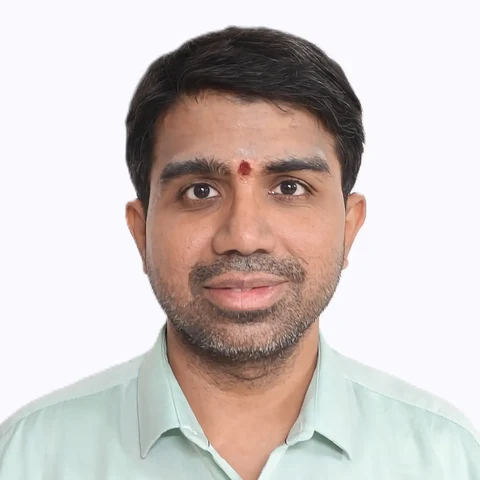
Professor, Department of Data Science & AI, Wadhwani School of Data Science & AI, IIT Madras
I build algorithms and computational tools to understand and design biological networks. Outside the lab, I tinker with Pañcāṅga (Indic calendar) calculation, Sanskrit typesetting, and a handful of other Indic-computing side projects.
✦ ✦ ✦
About
I was born and schooled in Chennai, and studied Chemical Technology at ICT Mumbai before moving to IISc Bangalore for a PhD in Systems Biology, advised by Nagasuma Chandra and Saraswathi Vishveshwara. A postdoc with Andreas Wagner at the University of Zürich followed, before I returned to India in 2011 to join the Department of Biotechnology at IIT Madras.
Today I lead RamanLab at the Wadhwani School of Data Science & AI, where we combine networks, models and AI to understand, predict and manipulate complex biological systems — spanning microbiome systems biology, in silico metabolic engineering, biological network design, and biological data analysis. I also coordinate the Centre for Integrative Biology and Systems mEdicine (IBSE), teach programming and computational biology at IIT Madras, and contribute to national AI-literacy efforts such as AI Samarth, and CBSE CT-AI Curriculum Development.
I have a strong background in computational science and, beyond my academic work, I am deeply passionate about astronomical computations, particularly those related to the Bharātīya pañchāṅga. I have been an active participant in the Shri Kanchi Kamakoti Peetham Panchanga Sadas since 2019. I have also computed and typeset location-specific panchaangas for hundreds of locations across India. The rest of this page tries to catalogue all my other interests — the side projects, mostly around संस्कृतम् and Indic computing, that I build for fun.
Research
Work in the lab broadly spans four themes. Full details, ongoing projects and the publication list live on the RamanLab site.
Projects
Mostly Indic computing — calendars, scripts and typesetting — plus the odd game. Some repos are private while they're still in flux; get in touch if you'd like a look.
Pañcāṅga & timekeeping
jyotisha is an open-source Python library for the astronomical and calendrical vedāṅga of the Hindus. It computes pañcāṅga elements — tithi, nakṣatra, yoga, karaṇa, muhūrta — from precise ephemerides, and generates location-specific festival calendars for any year in printable, HTML and ICS-subscribable formats. MIT-licensed, installable from PyPI. Co-maintained with Vishvas Vasuki.
adyatithi is the core festival database behind jyotisha — several thousand TOML records of Hindu observances, vratas and ārādhanās, each specifying its timing rule (lunar month and tithi, solar month, nakṣatra, or an offset from another event) alongside descriptions, scriptural references and śloka citations. Included in jyotisha as a submodule.
adyatithi — a newsletter on the Hindu calendar. Each post takes up a tithi, vrata or festival falling in the days ahead, and traces the observance to its Purāṇic or nibandha source. Dates are computed with jyotisha from the open adyatithi festival database, for several locations across the world.
A live web clock for traditional Indian timekeeping — divides each sunrise-to-sunrise day into 30 ghatikas (with finer subdivisions), computed from local sunrise/sunset, esp. for timing Sandhyāvandanam etc.
Scripts & texts
A “bridge” (setu) for learning various Indic scripts (lipi) — a gamified approach to learning one script (e.g. Telugu/grantha) building on the knowledge of another (e.g. devanagari/IAST).
A long-running effort to digitise and carefully proof-read Sanskrit stotras, and typeset them beautifully across multiple Indic scripts — a whole organisation of repos, one per text or script edition (see below).
Flashcards for learning Devanagari alongside other South Indian scripts (IAST, Grantha, Kannada, Telugu) — LaTeX-built printable PDFs plus a vocabulary spreadsheet.
Games & other
A Carmen Sandiego–style geography and culture guessing game set across India — currently in development. Clues heavily driven by ChatGPT/Claude. Inspired by the original game we played as kids, and the Google Earth version now accessible. Best viewed only on Desktop screens.
A word game based on falling letters — Tetris rules, Boggle scoring. Letters drop one at a time down a grid; instead of clearing lines, you clear words spelled left→right or top→bottom. A single self-contained HTML file, no build, no dependencies.
Sanskrit Texts
Highlights from the StotraSamhita organisation — classical Sanskrit texts, digitised, corrected and typeset in Devanagari (and other scripts) as proper LaTeX-built books, not just scanned PDFs.
A LaTeX-typeset archive of Sanskrit devotional hymns (stotras), sourced from sanskritdocuments.org, old scanned texts and elsewhere, and then corrected and typeset. This is the one that started it all — first published in May 2008, inspired by my grandfather’s handwritten collection. Compiled into one comprehensive volume, themed booklets (Navarātri, daily recitation, a children’s primer), and individual per-deity PDFs, across five page-size editions from A5 digital to Kindle Scribe.
Vedic texts of the Taittirīya Śākhā of the Kṛṣṇa Yajurveda in Devanagari: a curated Mantras collection for daily worship (Puruṣa Sūktam, Śrī Sūktam, Rudra Praśna, Sandhyāvandanam), the complete Taittirīya Āraṇyaka (ten Praśnas plus associated Upaniṣads), the full Taittirīya Brāhmaṇa (eight Aṣṭakas), and the entire Taittirīya Saṃhitā (seven Kāṇḍas). Typeset in the Siddhanta font, with digital, Kindle, Kindle Scribe, print and reMarkable editions.
A complete Devanagari edition of all 18 chapters of the Gītā, including the preparatory recitation (nyāsa) and traditional praise verses (māhātmyam), word-by-word padaccheda splits for every verse, and alphabetical verse and word concordances (~3,800 unique Sanskrit words) — bidirectionally hyperlinked between the main text and the word splits. Digital, Kindle, print and annotated editions.
A digitised, typeset edition of the full Mahābhārata across all 18 traditional parvas, based on the early-1900s Kumbhakoṇam edition (the Southern recension), digitised via the SARIT project. Built through a TEI-XML → per-parva JSON → LaTeX pipeline, with custom scripts to handle Sanskrit sandhi corrections along the way. Available as a full two-column edition and a Kindle-optimized single-column edition, plus standalone parvas such as the Virāṭa Parva. Only Virāṭa Parva has been carefully proofread.
A LaTeX/PDF edition of the Vālmīki Rāmāyaṇa, organized by kāṇḍa, generated through a JSON-to-TeX pipeline that automatically applies śloka macros based on line length and adds chapter annotations. Kindle and print editions.
The Adhyātma Rāmāyaṇa in Sanskrit — the philosophical and devotional retelling of Rāma’s story that frames Rāma as Brahman itself. Print, Kindle and Kindle Scribe editions.
A collection of Rāmāyaṇa stories gathered from across the Itihāsas and Purāṇas — supplementary narratives and episodes of Rāma’s life (rāma-caritam) beyond the core Vālmīki text, alongside related stotras.
A collection of śata- and sahasra-nāmāvalis — the 100- and 1000-name nāmāvalī-s recited for various deities — organized by count, with print, Kindle, and Kindle Scribe PDF editions.
A comprehensive collection of Sanskrit mantras, verses and step-by-step pūjā instructions for performing various pūjās and vratas at home — saṅkalpa, the sixteen upacāra offerings, deity-specific mantras, narratives from purāṇa-s traditionally recited during specific observances, and reference appendices for lunar months, constellations and ritual elements.
The Tulā Kāverī Māhātmyam — the Puranic text glorifying the sanctity of the Kāverī river, traditionally recited during Tulā Saṅkramaṇa, the sun’s transit into Tulā rāśi. Ongoing - alpha stage.